Monday, March 31, 2014

Home in GB


So this past week I left home (
Mechanicsburg with my parents) to come home (Garoua Boulai) waiting for the day when I can go home (Baboua) and regretting not having time to visit home (Pittsburgh) while I was in the US!  Someone said, “Home is where the heart is.” I glad that my heart is big enough to have multiple homes that I love.

The good news is that my father is making slow, steady progress with his physical therapy.  He must also go to dialysis three times a week.  I am glad for the progress and prayers everyone continues to send his direction.  I am back to phone calls home to keep in contact.

As I got back to Garoua Boulai, many people came to greet me.  I felt welcomed in many ways.  I missed being here for International Women’s Day on March 8. There are parties and a parade, they tell me.  Each year material is made to commemorate the date – a choice of two different colors.  I had bought a dress in the material, but didn’t wear it until I got back.  No sense taking a summer dress to then-snowy Pennsylvania.  Still, women wear the dresses even after the date.  I am, in fact, wearing mine now.  Here’s a glimpse. 

 As I got back four Central Africans were in GB (Patrick, Antoine, Mathias, and Cyrique) with a chauffeur from the Evangelical Lutheran Church of Cameroon (Denis).  They are here to arrange to take more of the rice and oil as Humanitarian Aid to Bouar and the surrounding area.  What a huge job – for so many reasons.  

Imagine having to load and unload trucks with 50 kg (100 lb.) sacks of rice and lighter, but more fragile boxes of oil.  Who will do it?  For how much?  Where can it be stored while waiting to cross into CAR?  Who will take it?  How difficult will it be to get through customs?  Will it be the same as last time? (Probably not…)

 There is a storage building on the Lutheran campus that workers have fixed up to make more secure and serviceable for storage.  It is currently filled with rice.  The products come from Yaoundé (or beyond) in trucks driven by Cameroonian drivers.  Most of them don’t want to take the chance to drive to Bouar in CAR – even though security is now good along the main road at least that far.  Others will take loads, but demand exorbitantly high prices.  The Evangelical Lutheran Church in Cameroon has agreed to rent their truck and driver to help out.  The truck is smaller so it means more trips, but at least food is getting where it is needed.  There are still complications, but maybe they are now better defined – if no easier to deal.  As I was writing this last evening, Pres. Golike, Patrick, Antoine, Josephine, and Abel arrived from CAR.  The first three are dealing with some of the complications today.  May it go smoothly!

This whole process has me thinking a lot about greed.  There are so many degrees of greed that raise are evident.  What is greed, really?  Dictionary.com says, “1. excessively or inordinately desirous of wealth, profit, etc.; avaricious: the greedy owners of the company; 2. having a strong or great desire for food or drink; 3. keenly desirous; eager (often followed by of  or for  ): greedy for praise.”  I think it is also wanting more than we need… Taking what belongs to others…

Or, maybe the better term for these latter definitions is delaying gratification.  If we can’t, we see, so we want.  We want immediately, preferably without effort and in large quantities.

We all experience this (whether it is greed or the desire for instant gratification) to some degree, but some of us have learned how to curb acting on the feelings.  Who hasn’t seen a plate of cookies in the kitchen before a reception and taken one, or two, or three…  Who hasn’t seen others eating candy and wanted some for him/herself?  But do we act on these feelings?  When does it matter?  Here are a few examples of why I’m thinking about greed/gratification now. 

The mango trees are full of fruit now, but much of it is still green (unripe).  Still, for the past month, youth (and even adults) have been climbing the trees to get it.  Or, throwing rocks and fallen mangos to make other fruit fall.  Why?  It is inedible.  You can tell from the many mangos on the ground that have had one bite taken out and then dropped because they are rock hard and have no taste.  I know people are hungry, but if all the fruit is wasted this way, there will never be ripe mangos to share. 

When I mentioned in GB that Willie had bought great t-shirts made for those distributing Humanitarian Aid to wear, a couple of local Cameroonians said, “I hope there is one for me.”  The shirts say Église Évangélique Luthériennne-République Centrafricaine, partnered with ELCA and Mission Afrika.  Why would a Cameroonian not working with the aid want one?  Of course, I saw the shirts and wanted one, too! (See selfie with the attempt to get the front and back of the shirt…)  I hope that I can make the case that it was appropriate for me to take one. 

Last week, after the weigh-station weighed the aid truck and charged them their fees (probably too high), the official then asked for a sack of rice and box of oil.  He knew this was humanitarian aid for those with little or nothing.  He had a job, a salary, and “gifts,” yet he wanted some of what he saw.  (They gave him none.)

Why are we so self-centered that want what is not ours, even at the expense of those who have much less?  Isn’t that a big part of the trouble, too, in CAR with the “rebels”?  How do we change or control these unhealthy appetites?  They damage us as much as those we take from. 


Monday, March 17, 2014

Snow and the Hospital - in Pennsylvania


St. Patrick's Day!  This is much more of an event in the US than in Cameroon/CAR.  Stating the obvious, I know.  I am aware of the holiday because I am currently in Mechanicsburg, PA because of my father’s medical crisis.  I am happy to report that he is out of the hospital and in rehab.  It will be a long, slow road back to where he was, but I am very grateful for the slow, steady progress.  Thanks to all who have been praying.  For those of you who are hearing for the first time, please feel free to pray for his continued progress and healing.

Mom fixing Dad's dinner tray
I have been stuck by the differences between hospitals in the US and Cameroon.  Wow.  Here’s a picture of the outside of Holy Spirit Hospital where Dad spent several weeks.  Look at the size!  He had to be in Intensive Care for a while and the array of machines and materials was truly impressive.  Because he had a couple of infections, we had to wear gowns and gloves to be in the room – everyone did and they had to be changed each time one entered the room.  Think of the number of gowns and gloves we went through!  I think we’ll be setting the new fashion trend – what do you think???

Dad at Rehab
When Dad was moved to Manor Care for rehab, we immediately noticed that his room seemed larger and quieter.  The hospital bed is there, but none of the other machines.  Nurses, aides, and therapists go in and out a lot, but it is still calmer.  He is very fortunate to be at a place that is well run and has extremely caring and competent staff.  What a blessing!

Of course, I flew to Philadelphia (and drove to Mechanicsburg with my niece and her boyfriend) at the tail end of the Polar Vortex – cold!  I could not have made the trip without much support in Cameroon – to get me from Garoua Boulai to Yaoundé airport, to arrange the ticket, and even to lend me a coat and gloves.  Many thanks to friends there.
 

 Here’s a couple of snow pictures from around my parents’ house – not so deep, but much more than we get in Garoua Boulai!  Since I arrived, it has been warmer and the snow is melting, but they are talking about cold again today with possible snow.  Ah, March – in like a lion and out like a lamb (if we are lucky).


Later in the week!


I will be going back to Cameroon soon, so the next blog entry should be from there again.

Wednesday, February 26, 2014

Roofing the Church, Part 1


Companion synods have regularly come to Cameroon (South Dakota synod) and Central African Republic (North Dakota – East or West or Texas/Louisiana/Gulf Coast synod) to help churches put roofs on their newly constructed buildings.  Congregants collect building materials (sand, etc.) buy cement (or is it concrete?), make cinder blocks or mud bricks, build the foundation, and then raise the walls. 

The US churches pay for wood for the rafters and the corrugated tin for the top.  Then a group from the US comes to help with the roofing process.  Just such a group came to Cameroon last week.  They worked on two roofs, one not too far from Tibati and the other, at Garoua-seeye Church here in Garoua Boulai.  12 South Dakotans came along with Phil Nelson (financial administrator who lives in N’gaoundéré and who has lots of experience with this program), Denis (driver), and some carpenters (also from N’gaoundéré).  These latter stayed in the neighborhood near the church, but the guest houses were full with the other 14! 

I helped with the logistics – arranging for some local women to make the food and making sure there were enough guest house beds.  Originally, they were to come Monday, February 17, but there was some fighting just over the CAR border Sunday evening.  Although calm came back immediately and Garoua Boulai was not directly affected, organizers decided they would go to Tibati first instead of second to be sure all was safe (especially because the church is only a short distance from the border).  The group arrived in GB on Fri.  That meant, though, that the caterers had some food that had already been bought and that couldn’t be saved for three days.  Instead of having it spoil, we sent bananas and plantains (the kind of bananas that have to be cooked) to the church where carpenters and volunteers were working on preparing the rafters.  Waste not, want not, right?

Once the group arrived, they ate breakfast and dinner at my house (with food from the caterers who also washed the dishes) and lunch at the church.  Lots of people in and out – but interesting and fun.


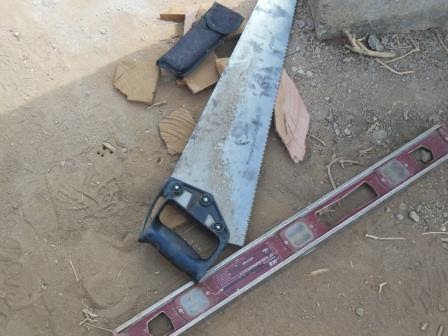
Saturday was the first full day of work.  Workers used tools you would expect, including power tools – run by a generator. 

I didn’t go with the group to the church, but about an hour later the Director of the Bible School and I went over to see the progress and take some pictures.  Just as we were leaving, there was a huge crash!  All of the rafters tilted over and fell into the church.  Wow.  There hadbeen about 5 Cameroonians up on top nailing boards in place and about 10 others (from the US and Cameroon) inside preparing rafters.  It was a miracle – no one was seriously injured.  We did take about 5 people to the Protestant Hospital for the Dr. Solofo to check.  Mostly scrapes and bruises, one twisted ankle, and one American who got a nasty lump on the back of his head and another on his arm.  (Later he was taken to N’gaoundéré (since the x-ray machine in GB is not working and kept in the hospital for observation for a night to be on the safe side.  He is fine although a bit sore!)

As the rafters fell in the two long walls broke from the foundation and were tilting in.  Immediately, workers put supports for one of the leaning walls, brought the rafters down to the ground (and they can be reused), and then pulled down the other leaning wall.  Later, the second wall was also taken down.  Now congregants need to get more supplies, make more cinder blocks and rebuild. Later the roof will be added, though the South Dakotans will not be there to help.

How could this have happened?  There were many factors, some of which I am sure I don’t know, but I can repeat theories I have heard.  There had been some wooden supports holding the rafters at one end that were removed early because they needed the wood for something else.  Also, this church is to be the largest in GB.  It seems that the workers didn’t know how to support longer walls well.  The rebar probably should have been thicker; the foundation should have gone deeper; and pillars or other supports should have been planned.  


Everyone was glad that the collapse happened now and not later when the church was full of congregants!  It is certainly a major setback, but everyone is determined to rebuild and complete the church.

Sunday service was held in the old building (beside the one being built).  People were happy to have the South Dakota visitors, but as several Cameroonians said, everything was much more subdued than the singing, dancing, and celebrating that had been planned. 

Still, each time the incident/problem is discussed (often here in GB!) people first thank God that no one was seriously hurt and that the problem was discovered before a catastrophe happened.  So, this was Part 1 of the roofing of the church for Garoua-seeye.  Part 2 will come, but sometime in the future – by the grace of God.

Since the visitors had some extra time Monday, they got to visit the nearby (Lutheran) Protestant Elementary and Middle Schools and the Bible School.  We also went to the market for some to buy cloth which was made into dresses/shirts.  And, some were able to buy paintings/banana leaf pictures by local artists and some wood carvings.  The group left Monday for N’gaoundéré where they helped unload the container (sent by Global Health Ministries and full of medical supplies and other gifts from the States).  They are currently visiting a game park before they take the train back to Yaoundé and fly home. 

I have sorted gifts they left for churches and the hospital, put the house back in order, and gone back to my “regular” life! 

Sunday, February 16, 2014

Fire


I have always had a healthy respect for fire – and a certain fascination with it.  Watching flames (of a candle or fireplace) can be calming and beautiful.  I cook on a gas stove (here and in Pittsburgh before I came.)  On the other hand, having a huge fire near your house is much more of a concern!

This is the dry season, so, as I mentioned last year, people burn the brush.  Again, this year, I asked why.  I got some of the same answers as last year.  It is the tradition and it cleans up an area.  Those who hunt field rats do it to chase out the animals to kill.  Having no underbrush makes hunting easier.  And, for herders, burning the brush clears the way for the growth of tender shoots which the animals like.  Most of those answers do not apply for the area around my house.  Yet, this afternoon, someone burned the area behind the house.  I watched mesmerized – and hoping that the flames would not cross the very short, dry grass between the fire and my house.  It didn’t get out of control and didn’t burn everything.  Taller, greener plants and trees remain.  


 Here are some photos.  I could hear the cracking before I could see many flames.  Then it would seem to die down a little until it hit another big clump of dry brush.  Flames were often 10-15 feet in the air!  In the US we would have been working to put it out.  In about 30minutes, an area the length of a football field was burned.  (I don’t know how wide the area was since I didn’t want to go closer to investigate!)

Still, not all burns are this successful.  If the wind picks up (which it often does in this season), the fire can go in unexpected directions and get out of control.  Two of the Village School Program villages had such a problem.  In the first case, one of the teacher’s children died in a house when the brush fire got out of control and burned the house.  In the second village, the “hangar” (the open-sided classroom with a thatched roof) burned.  The parents cannot yet rebuild it because the whole area burned and there is no grass to use as thatch until the rains come again.   Fortunately, parents were able to save the chalk boards and student table/benches.  They have made an arrangement with the local Lutheran church to hold classes inside until repairs can be made.  (You might think that classes could still be held outside because it is not currently raining, but the sun is too hot!)

I wonder about the environmental impact of these fires.  In addition to the bush, people also burn some trash and piles of leaves.  (No, leaves don’t fall as cold weather comes, but they do fall because of dryness.)  In the USA, people used to burn trash and leaves.  Most communities now have ordinances against burning – to protect property and the environment, I think.  On the other hand, the forest service often now allows natural fires to burn without trying to put them out – as a natural part of forest life.  I wonder if anyone has studied the effects of burning the bush in Central Africa to determine its pros and cons.  I know that it is the tradition here and would be hard to change if research recommended it – despite occasional tragedies. 
 
Fortunately, during the fire near my house most of the smoke blew the other way.  Fortunately, too, it served its purpose without getting out of control.  I will end by saying that I was fascinated to watch the fire.  Maybe I was just thinking of those of you in cold climates who might be sitting by a fireplace fire on these very snowy, cold days where you are!