Saturday, July 5, 2014

Louisiana and Texas, Part 2

I continue to have wonderful experiences as I travel to talk about my work with the Evangelical Lutheran Church in CAR and answer questions about the situation there.  (I can note that I am ready to be in one spot for longer than a couple of days, but that goes with the territory after 5 weeks of travel and presentations!)

In the past week, I visited Louisiana and Brenham and Katy, Texas.  Today I go to Lake Jackson; after liturgy there tomorrow I will be flying back to PA (from Houston).  On the road again…  I can definitely say that my knowledge of Texas and Louisiana’s geography is improving, but is still inadequate.

Charles Short picked me up at the airport in New Orleans and drove me to his home north of Baton Rouge.  I gave a temple talk, children’s sermon, and presentation (at lunch) at his church, St. Paul’s, Baton Rouge.  That Sunday afternoon he and I visited the state capital building in Baton Rouge where I was reminded of some of the state’s history, especially related to Huey Long who had the building build and where he was shot (bullet hole still visible in the marble.)  We also visited an old Episcopal church (Grace) with its cemetery and other places around Feliciana Parishes (East and West), including Cat Island which is now a Wildlife Management Area.

Baton Rouge and New Orleans are at the mouth of the Mississippi River.  Some coal barges we saw remind me of those we seen on the rivers around Pittsburgh.  In fact, some of these, no doubt, come from PA coal country – down the Ohio and Mississippi Rivers.  We are all connected. 

In the evening we had dinner with people from St. Paul’s at P. J. Chang’s, one of a chain of Chinese restaurants.  I had never heard of them, but will definitely keep my eyes open to eat in another one if I have the chance. 


Monday Chuck was again tour guide to show me some of the French Quarter in New Orleans.  I got to sample beignets (French donuts – similar, but not the same as the beignets in CAR/Cameroon).  I can say that New Orleans better fits my old image of cities.  It is built an area with limited space and started long ago.  Streets are narrower (than Houston and Fargo, for example) and many buildings are taller.  It is true that there is a lot of Spanish (and some French) influence in the buildings and there are horse-drawn carriages in the Quarter which exist in NYC and Philadelphia, but not many other of the cities in eastern US. 

We also met with Rev. Bonnie Parker and Kim at Gethsemane Lutheran in Chalemette (just outside of New Orleans)  This is an area that has been hard hit by flooding (from hurricanes) on several occasions. Rev. Ken Shuman from Church of the Galilean of La Place, LA was also there.  Turns out he had served as pastor in Sharpsburg (near Pittsburgh, PA) and had his church flooded there after a hurricane only to arrive in LA and have a repeat performance (by the effects of a different hurricane).  Small world. 

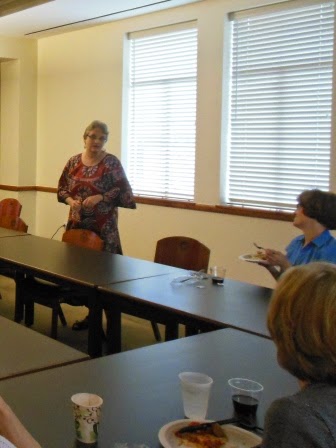
Back in Texas I visited Rev. Alan Kethan in Brenham.  He currently serves St. Peter’s and First Lutheran churches (but is soon moving to Columbus, TX).  I also spoke at St. Paul’s and to the deanery (area
conference) meeting. (This picture is from St. Paul’s.)  
Pastor Alan took me to see some of the Brenham area, including the Antique Rose Emporium.  Beautify roses and flowers cultivated) from old plants (some going back to the 1800s) set on gorgeous grounds.

I continue to be warmly received everywhere as I eat my way through visits!  Hospitality naturally includes delicious food and lots of it.  I may have to roll back to the plane, though.  Good thing they don’t weigh me before and after or I would be charged for the extra weight I am sure! Everyone tells me that I have also been fortunate since temperatures are running below normal and are only in the high 80s in the afternoons.  Mornings and evenings have been pleasant to be outside. 

Yesterday was the Fourth, Independence Day.  Mine was calm and restful – just what I wanted.  I spent it with the Drees family; we had grilled hamburgers and turkey burgers and saw some fireworks.  All was well! 


I hope you are all enjoying your weekend and had a great Fourth of July celebration.  

Sunday, June 29, 2014

Texas, Part 1

Texas is the biggest state of the union (if you consider only the lower 48); it’s so hot in Texas, why would
you go in the summer?  Texans drawl and wear cowboy hats and boots.  Well, there’s a handful of generalizations and facts!  Texas is big and I am visiting airports – Houston, San Antonio, and Dallas.  I don’t have much time to visit cities and places, but am meeting many friendly, dedicated supporters of my work and the many other projects in the Central African Republic.  Temperatures have been moderate (cool for the summer) although humidity has been high – but it doesn’t matter much since we spend much of the time in (often way too cold) air conditioning.  I rarely hear a “drawl” and have seen only a few cowboy hats and boots.  I have seen MANY pick-up trucks.


I am enjoying my time.  Starting on a personal note, I have been walking – around the Heights in Houston (beginning of walking esplanades pictured), Texas Lutheran University (TLU) in Sequin, and into/around the town of Sequin.  I have to revise my image of a city.  So much of what we hold in mind is unconscious and shaped by our experiences.  Most cities I know are in the East where space is more limited and ground less flat.  A city for me has tall buildings, streets with one line in each direction plus parking or one way streets with one lane (and maybe parking).  As I found in North Dakota, cities here are spread out, buildings are a couple of stories tall, and streets are wide.  It feels less crowded and “un-city-like” to me.  I am revising my views!  (Isn’t that part of what travel is for???)  And, I had believed that cities don’t have cacti! 

I have been welcomed by various Lutheran communities.  (Here’s a picture of TLU’s statue of Martin Luther, the man who has inspired our view of salvation by grace through faith with the Bible as a yardstick.)


First, I was in Houston at Christ the King (addressing a group of adults) and Faith Lutheran (addressing the Bible camp, pre-school students at the Day School, and adults in the evening.  Then, in Sequin (at TX Lutheran University), I attended the Disciple Project, intergenerational leadership training designed and implemented in the Texas-Louisiana Gulf Coast Synod.   In all three places I have presented information about my work and the situation in the CAR and had great conversations with many people.  At the Disciple Project I also learned about LEAD, Living Everyday as Disciples, a year-old program that focus our life and work on Listening Up (to God), Listening In (to ourselves and our church groups) and Listening Out (to communities) as we strive to follow Christ’s example in our lives.  I attending sessions called “Following to Lead.”  About 15 of us learned about Sequin as we learned to listen to others (asking open questions to better get to interviewees to share information from their perspective).  We all designed the beginnings of a project that we will take back
to our community with the intent of listening and then serving some segment of our community. I also got to speak to the children and learned to use Wordle (see photo).
 
Each day the Bible study included JR telling the gospel story/text.  He is a member of the same organization of Biblical Storytellers whose training I attended in Anglophone Cameroon last year.  Small world!

I also learned some unexpected things (besides revising my view of cities!)  I heard and saw many mockingbirds.  They are the state bird of Texas (and Arkansas, Florida, Tennessee, and Mississippi) and are very pretty with the white stripes on their wings and bodies.  They mimic the cries of other birds and are featured in songs and books.  Wikipedia says, “It also features in the title and central metaphor of the novel To Kill a Mockingbird, by Harper Lee. In that novel, mockingbirds are portrayed as innocent and generous, and two of the major characters, Atticus Finch and Miss Maudie, say it is a sin to kill a mockingbird because "they don't do one thing for us but make music for us to enjoy. They don't eat up people's gardens, don't nest in corncribs, they don't do one thing but sing their hearts out for us".’


These birds are protective of their nests which I saw in the form of them chasing squirrels even though they didn’t seem to be close to a tree (and therefore a nest)!  I couldn’t get a picture of these chases, but photographed as squirrel and found a picture of a flying mockingbird online…


I am writing this as I sit in the Dallas airport on my way to Baton Rouge, Louisiana via New Orleans.  (Yes, Dallas is the wrong way to get from San Antonia to New Orleans, but that’s the way flights work sometimes.)  I will get this ready and send it from LA. 


Monday, June 16, 2014

Rainy "Home" Visit


I am in the Pittsburgh, PA area this week – home (or at least one of them).  I spent Thurs. through Saturday at St. Vincent’s College, Latrobe at the Southwestern PA synod assembly.  This was my third assembly in three weeks.  (I can say that I am glad not to be churchwide staff who have to attend multiple assemblies every year!)  As I expected, I saw more people I knew and met many others.  My two forum sessions went well with more people in the 9 a.m. one than the other at 4 p.m. (To be expected...)  Here is a picture I took of Bishop Kusserow during a plenary session. 

It has been rainy all week.  Many days I have continued to walk most days.  Here’s an attempt to share a gorgeous cloudy sky between rains taken in Latrobe.  We even had a thunder storm one day with thunder and great lightning – reminding me of storms in Garoua Boulai.

On Sunday, I was hosted by Zion Lutheran Church in Harmony, PA.  I preached a children’s and adult sermon and shared conversation during coffee hour after the liturgy.  Pictured here is Rev. Barbara Love and me sitting at coffee hour.
I have a few more days in Pittsburgh and then back to Mechanicsburg and on to Texas next Sunday.  Travels continue!

Friday, June 6, 2014

Still Flat and Friendly, But Less Windy


On the Road Again, arriving in Mechanicsburg, PA

What a wonderful opportunity to meet people and see part of Eastern North Dakota!  I drove to Kindred and Fargo, North Dakota and Moorhead, Minnesota.  Between Bismarck and Kindred I passed many farms and LOTS of flat land (not a surprise, really).  I went to Kindred first as the Lutheran Church there has been supporting me.  The town is small and lovely.  Many more wood houses than we see in Pennsylvania and wide roads.  (The picture was taken from my window seat on the plane from Minneapolis to Philadelphia.  The fewest clouds I have seen in a long time on a flight – and one of the bumpiest rides!  The water is Lake Michigan.) 

After sharing the liturgy with Kindred Lutheran (and preaching), three women took me to the Hjemkomst Center to see the Stave Church that is a replica of a church in Norway that was built in the 1100s.  Great to see.  An interesting point was the lepers’ window.  The pastor could give communion to lepers (and others with sever illnesses) from a place near the altar while lepers stood outside on a covered porch.  Exclusion, but also a way to limit the spread of disease. The center also has a replica of a Viking ship that was built and sailed to Norway in the early 190s. 

I also got to see the Welcome Home parade for the girls’ softball team from Kindred who won the state championship!  Go girls!  Sunday evening Kindred Lutheran welcomed some bicyclists riding for Gears for Change.  They road across the state to raise money for the homeless.  One of the riders was Pastor Sue whose church I visited two days later.

Note about homelessness in ND:  There has been some homelessness in Fargo and other areas, as there is everywhere, but the situation is getting worse.  There is an oil boom in the western part of the state because of fracking techniques that are allowing access to resources that were not easily removed before.  Because of the influx of workers in this boom, housing is very short.  Many landlords, going with supply and demand, are now raising rents exponentially so that those on limited or fixed income are being evicted.  Too many are now homeless and many have moved to Fargo.  The churches are working together to address the problem as are others in the area.  I can’t imagine being homeless in the winter when temperatures are often below zero with lots of wind.

Both Monday and Tuesday mornings I spent time at the Eastern North Dakota synod office where I met the current Bishop, Rev. William Rindy, and the Bishop-Elect, Terry Brant, and various other staff.  Tuesday afternoon, I also had the chance to visit personnel at the Northwestern Minnesota synod office including Bishop, Rev. Dr. Lawrence R. Wohlrabe.

Monday evening I stayed in the home of Nola and Ken Storm who invited the Mission Committee from Olivet Lutheran.  This church along with two others to be mentioned soon have decided to begin to support me in my work in CAR.  All three had been supporting June and Phil Nelson who finish their work in Cameroon in July.  I am sad to see the Nelsons leave, but am gratified that these churches have so quickly moved to choose a new missionary to generously support.

Tuesday evening I presented some information about my work and life in CAR to the Intergenerational Vacation Bible School at Elim Lutheran in Fargo (who will begin sponsoring me this summer).  This picture shows an another outside activity where we demonstrated that the love we receive from those around us (represented by water in paper cups) come together in ways that overflow (shown by the overflowing bowl into which each person poured his/her water while naming someone who loves him/her).  

Finally, on the way back to Bismarck to fly to Pennsylvania, I stopped in Valley City at Our Savior Lutheran Church (who will also begin to support me this summer).  I participated in the regular Wednesday Bible study sharing information about my work and the situation in CAR.  I also went with members for a coffee and continued conversation. 

Thanks to Pr. Paul Schauer’s habit of daily walks, I got into the groove, too.  I walked for 45-60 minutes each day, plus regular walking to get from place to place.  I am pleased to be moving – and balancing the wonderful meals I have been eating with all of the people I have been meeting!

I only allotted a week in North Dakota thinking I was vising three places.  I was blessed to visit seven!  It is helpful to put names to faces and places and these visits will facilitate/encourage communication in the future.

Today, I presented a forum at the Lower Susquehanna Synod Assembly entitled, "Feeding Spiritual and Earthly Hunger in the CAR."  It went well and participants had good questions.  Bishop Jim Dunlop introduced me during the first session explaining that we are even related!  His wife’s brother is my sister’s husband – got that?  As he said, that means mostly shared turkey dinners!

Another big thank you to all who are making my travels smooth and fruitful.

Sunday, June 1, 2014

Windy, Flat, and Friendly

I have started visiting supporters and
what a great way to start!  I arrived in Bismarck, North Dakota Wednesday afternoon.  Pastor Paul Schauer met me at the airport and I have been staying with him.

That same evening I spoke to Sunne Lutheran Church’s Vacation Bible School. Since then I have been at the WND synod assembly.  I got to speak during the Gala organized to raise funds for the Central African Republic where I gave an overview of my work.  The next day I was able to speak to the whole assembly about the ELCA’s part in Humanitarian Aid to CAR.  I’ve also have various opportunities to speak to people informally.  The Rev. Dr. Andrea Walker, Area Director for Western and Central Africa, was also at the assembly and led a forum session.

This is my first visit to North Dakota.  My first impressions are that people are very friendly and welcoming.  I am pleased to meet the people who are so open to supporting missions around the world, including in the CAR.

I can also say that it is WINDY here!  I guess I should have expected it because the area is very flat and the wind comes from far away and builds up speed with few hills, mountains, etc. to slow things down.  It was particularly windy on Thursday.  The weather is also cooler than in PA (overall) and spring is several weeks being PA.  On the other hand, Thurs. the temperature was in the upper 80s.  Today, though, it is in the upper 60s. 

It is no wonder that there are now many wind towers in the area producing electricity.  I’m told that sometimes they have to turn them off because the wind gets to strong!  Imagine.

I have had some time to see sites in Washburn, Wilton, and Bismarck.  Merriweather Lewis and William Clark came through this area in the early 1800s as they mapped, explored, and collected plant and animals aided by Sakakawea and other Native Americans.  In fact the highway on the east side of the Missouri River is number 1804 and on the west side it’s 1806 to commemorate the years the Lewis and Clark passed through the area.  Much of the area looks like it did when Lewis and Clark passed through. 

Here’s a picture of the famous team with Pastor Paul included in the consultation.


This will be posted from Eastern North Dakota when I find an internet connection.  I am pleased to be able to visit this part of the state, too, but will write more about that another day.  

Monday, May 26, 2014

Buying Food

Thanks to those of you who sent blog entry topics!  (Other suggestions taken at any time.) Here’s a response to one of those ideas.

Where do you go to buy food?  Most likely, if you live in the US, you most often go to a grocery store, but maybe you also shop at farmers’ markets, convenience stores, or fast food and slow food restaurants.  There’s a huge difference between shopping in the US and in Cameroon or the Central African Republic. 

Let me first say that there are restaurants in towns in Cameroon/CAR.  People also buy fast food!  There is no chicken or burger joint, but as dusk approaches women come to the edges of the roads to make beignets (doughnuts without holes), grilled meat and fish, grilled corn on the cob (in season – and not sweet corn that we usually eat).  Food can be delicious, but buyers must beware because sanitation standards are not always what we would like. 

Most people in Cameroon/CAR buy most of the food in the local market.  Well, that is, most food that they don’t grow themselves (most often manioc-cassava, but also corn,
sweet potatoes, and/or some vegetables).  It is like our farmers’ market, but not as formal. In smaller towns, the main market is once a week.  In the market, women sit on the ground and display their wares in front of them.  Around the edges of that market are “boutiques,” small shops where (mostly) men sell soap, sugar, canned goods, some vegetables, etc.  On nearby tables butchers sell beef.  Chicken and goats are sold live to be killed and prepared at home.  Fish from rivers and those sold frozen must be scaled and cleaned at home.


In the US everything is package to keep it sterile – well, and to make it less messy.  That doesn't happen in Cameroon/CAR.  Venders now have plastic bags to package what is bought although they are thin and break easily.  In that way, the two countries are the same.  In both places, you can bring your own bags, but most people don’t. 
  
Junk food is sold in both areas, but the US has a much larger selection.  The US also has MANY more prepared foods – chips, pretzels, dips, but also frozen foods, prepared dinners, chopped up lettuce, vegetables, cheese, etc.  Going to a supermarket can be overwhelming.  How many kinds of dip or salad dressing do we need?  (Although I have to admit that sometimes I can’t find one I like or the one I want…)  There are many more obese people in the US than Cameroon/CAR – surely related to junk food, but also to the quantities that are available. 

In a book I read an African commented that grocery stores in the US don’t smell.  You can’t smell food of any kind.  Maybe you can smell products used to keep the store clean, but store owners seem to sanitize everything so you can’t smell fruit or meat – not the tantalizing good smells nor the not-so-pleasant ones of food that is turning bad or been in the sun too long.  (Of course, since supermarket food is not ever in the sun or exposed to natural temperatures, that could be another factor…) 

In Cameroon and CAR the market is full of smells:  ripe fruit, manioc flour (surrounded by bees), meat (that smell is overpowering, in my opinion), the people selling and buying, and much more. 

Food choices in Cameroon/CAR are more limited than in the US that now get lots of fruit and vegetables from Chile, Mexico, and many other places so shoppers pay much less attention to what is “in season” (unless they try to buy locally).  Central Africans can also get some foods that are shipped in – pineapples from about 6 hours to the south, apples from South Africa, etc., but these items are more expensive and less available, so less accessible to most people. 

Foods I have bought in Garoua Boulai, 
Cameroon: (Celery and basil are often sold together – second picture; there are more and better varieties of bananas there!)


I have been encouraged to see that the markets now have a widening variety of vegetables. (More so in Garoua Boulai, Cameroon than Baboua, CAR.)  Central Africans are beginning to eat more of them, but are often limited by cost, availability (and lack of habit of eating them).

Most women are the ones who shop for the family.  They go to the market almost every day.  Since they usually cook over wood fires outside (or in a small kitchen building similar to colonial summer kitchens – but smaller) and have no refrigeration, it is necessary to buy smaller quantities more often. 

Most people live with extended families and have limited funds – so limited quantities of food.  Many times they don’t have left-overs; it all gets eaten.  They don’t have freezers either to prepare larger quantities and freeze some for later (as I often did in the US and do in Cameroon/CAR).  Their lives are as busy as those who live in the US, but with different activities.  They farm, sell crops, buy and prepare food…  People in the US work at jobs, work out in gyms, commute, etc. – spending much less time buying and preparing food.  No wonder those in the US go for prepared meals and shop in larger quantities.  No wonder they buy a huge refrigerator and an extra freezer. 

On both continents there are hunters who bring home meat.  In Cameroon/CAR that meat is more likely to be smoked or part of it sold quickly so it doesn’t spoil.  People in the US tend to freeze it nowadays, especially since they have to hunt during limited seasons. 


Everyone must eat.  But living in different places means figuring out the best ways to shop and prepare the food.  Maybe, on this Memorial Day, you can stop and reflect on what you eat, where it comes from, and how it is prepared.  Let us live (and eat) simply, so that others may simply live.  

Friday, May 16, 2014

Home Assignment Visits and Request for Topics

I am very thankful for the many people who support the work of the Evangelical Lutheran Church – Central African Republic and my work with this church.  I especially appreciate all those who have not yet met me!

I will have the opportunity to meet many supporters starting at the end of May.  I will be visiting: North Dakota (east and west), Texas, Louisiana, Iowa, Minnesota, Illinois, Delaware, and, of course, Pennsylvania. 

I have, in fact, already had the chance to talk to people at my home church, East Liberty Lutheran Church in Pittsburgh, PA and most of the students at my “old” school, Phillips Spanish Emphasis Elementary School (also in Pittsburgh).

Singila mingui (many thanks) again to all who support work in the CAR – in all of the ways that you do it.  Hope to see you soon!


It is much harder for me to think of blog entry topics while I am here in PA.  Here’s your challenge:  Pick some aspect of life in the US which you would like me to compare to life in CAR/Cameroon.